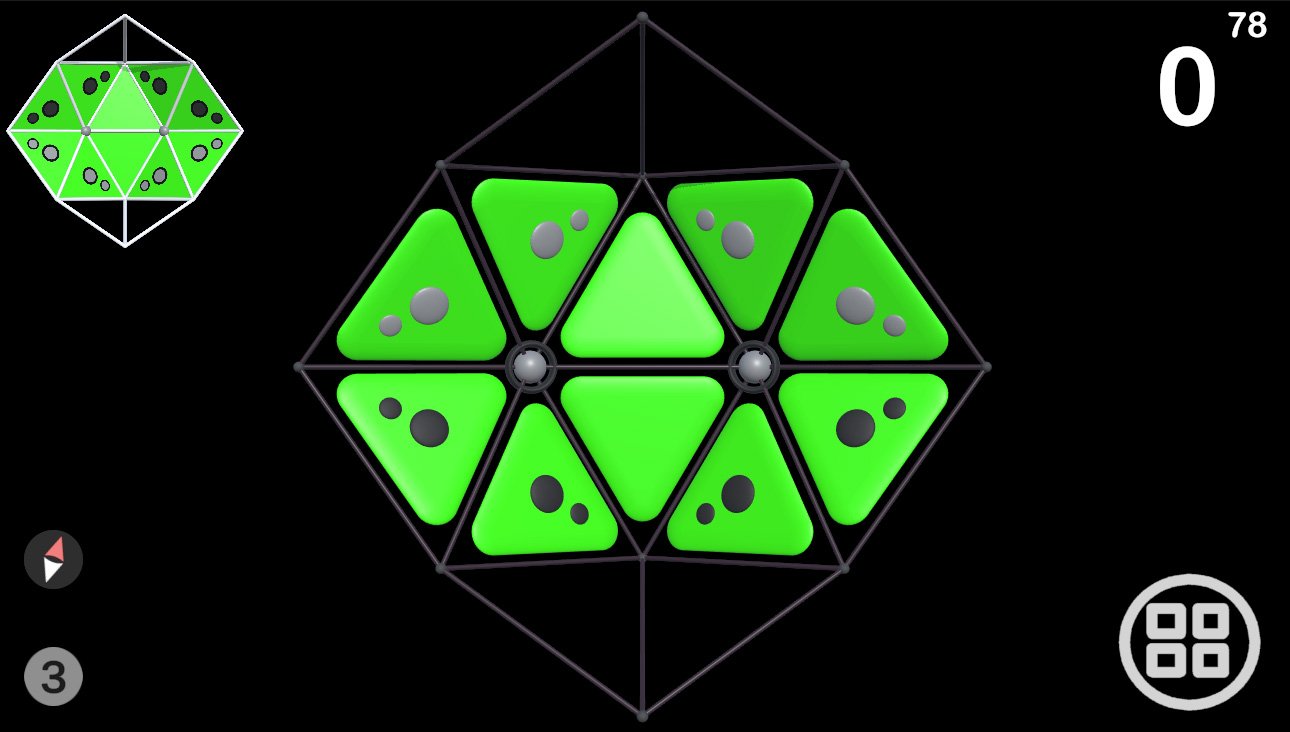
Rotation Types
The Rotators move their triangles clockwise or counter-clockwise (cw / ccw).
But the way a triangle changes its orientation during a move can vary. This is what we call the rotation type.
There are 6 rotation types:
Each one describes a different way the triangles behave as they move around a rotator.
If a puzzle uses more than one rotation type, the color of a rotator shows which type it uses.
If all rotators use the same type, the colors are only decorative.
The 6 Rotation Types
Type 1 — Vinyl
The triangles move around the rotator without changing their orientation.
They behave like pieces lying on a vinyl record:
the position changes, but the triangle itself does not turn.
Type 2 — Spin Forward
The tip facing the center is pushed forward in the direction of the move.
After the move, a triangle that pointed toward the center will point forward along the direction of movement.
Type 3 — Spin Backward
The tip facing the center is held back as the triangle moves.
After the move, a triangle that pointed toward the center will point backward, against the direction of movement.
Type 4 — Center Flip
The triangles flip over the axis between them.
The tip pointing toward the center stays pointing inward, but the triangle is flipped to the other side.
Type 5 — Clockwise Conserved
The triangle flips and rotates so that its clockwise-facing tip keeps pointing clockwise after the move.
This is true whether the move itself is made clockwise or counter-clockwise.
In other words:
clockwise is conserved.
Type 6 — Counter-Clockwise Conserved
This is the counterpart to type 5.
The triangle flips and rotates so that its counter-clockwise-facing tip keeps pointing counter-clockwise after the move.
So here:
counter-clockwise is conserved.
Why these 6?
The 6 rotation types currently used in Trinagon VR all follow one important rule:
Every move can be taken back by performing the same move in the opposite direction.
So if a rotator moves clockwise, the matching counter-clockwise move undoes it exactly.
This rule is not immediately obvious, but it is very important.
It means that “moving back” and “undoing” are the same thing.
That gives the puzzle a clean structure:
- moves have clear opposites
- scrambles can be reversed step by step
- the player can understand the system through movement
- the puzzle behaves in a group-like way, where every move has a matching inverse
This is why the current 6 rotation types feel mathematically stable.
They are different, but they all respect the same basic rule of reversibility.
The strange case of types 5 and 6
Types 5 and 6 are special.
If you watch them closely, especially in slow motion, you may notice something unusual:
Type 5 does not look the same when played clockwise and counter-clockwise.
The same is true for type 6.
Most other rotation types look like clean mirrored versions of themselves when the direction is reversed.
But type 5 and type 6 do not.
Why?
Because two things are happening at once:
- the triangle moves around the rotator
- the triangle also flips according to a conserved direction
The movement direction changes when you go from clockwise to counter-clockwise.
But in type 5, the conserved direction stays clockwise.
And in type 6, the conserved direction stays counter-clockwise.
So only part of the behaviour reverses.
That is why the animation can look asymmetric.
You may even notice that:
type 5 clockwise visually resembles type 6 counter-clockwise,
and
type 6 clockwise visually resembles type 5 counter-clockwise.
This is not a bug.
It is a consequence of preserving a fixed clockwise or counter-clockwise side while the movement direction changes.
The two possible extra rotation types
Interestingly, there would be room for two more rotation types.
They are not currently used in the game, because they would no longer follow the same simple rule:
the opposite movement direction would not be the undo move.
They would still be reversible.
But the reverse move would be a different type of move, not simply the same move performed backwards.
This means the system would still allow undoing, but:
undoing a move and moving back would no longer be the same action.
Rotation 7 — The natural hook
One possible extra type would be a natural “hook” motion.
The center-facing tip would lift, and the triangle would spin forward into the direction of movement.
So if the triangle moves clockwise, it also spins clockwise.
If it moves counter-clockwise, it also spins counter-clockwise.
The movement and the spin support each other.
This makes the motion feel natural:
the triangle moves and turns in the same direction.
Rotation 8 — The anti-hook
The other possible extra type would be the opposite.
The center-facing tip would still lift, but the triangle would spin backward, against the direction of movement.
So the triangle would travel one way while its spin suggests the opposite force.
This would look much stranger, almost like the motion is fighting itself.
But mathematically, it would be the counterpart to rotation 7.
Rotation 7 would be the natural hook.
Rotation 8 would be the anti-hook needed to undo it.
A more difficult system
These two extra rotation types could create interesting new puzzle behaviour.
But they would belong to a more difficult system.
In the current game, if you want to undo a move, you simply move back.
With rotation types 7 and 8, that would no longer be enough.
A clockwise type-7 move would not be undone by a counter-clockwise type-7 move.
Instead, it would need its corresponding opposite: type 8.
So the puzzle would still be reversible, but the relationship between moves would become more complex.
That is the difference:
The current 6 types are direction-reversible.
The extra 2 types would be reversible, but not direction-reversible.
For now, Trinagon VR uses the clean set of 6.
But the two hidden possibilities remain: a natural hook and its strange reverse.