
- Details
- Hits: 890
Trinagon was born in a different time (like 1988 -another millenium / century).
A time where the average attention span used to be more than 5 seconds.
A time when immediate gratification was not the norm. Rewards had to be earned. (They actually still do - at least real rewards.)
Games, regardless if in real life or in virtual, needed an effort to learn. Nothing ever was self explanatory, and you were lucky, if there were any explanations at all.
Reading a book, getting deep into a story, and exploring with an active mind was necessary. Having to suss things and life out mostly on your own.
Whenever we got a new game on our Commodore 64, we always quickly went through all the keys on the keyboard to find out if they had any functions :)
Now compare that to the games kids aged 5 to 11 get delivered.
The 'game', often nothing more than a simple-minded tapping or shifting / moving, likely will be boring to a dolphin within a few minutes. (because dolphins are sharp :))
Yet, they offer easy entertainment and quick gratifications. (Hurraai, you just tapped the red button. Whao ! Boooom. Level 58 solved.) Without those the 'players' will turn away within the first seconds.
Sure, this IS grossly exaggerated, but there is truth in it.
This demand for easy entertainment and quick gratifications comes with a price.
A high price.
It is the expectation for everything to be easy, expectation to be lead every step on the way, and needing gratifications and rewards to keep going, long even before the going could get tough.
It nourishes a specific mindsetting, one that leads to dependence and usually someone else doing the thinking, learning and heavy lifting. And interesting enough, it also includes believing to be entitled to that service.
If this is your mindset & your expectations :
Forget Trinagon. It's not for you.
Trinagon will give you a hard time on the occasion. Trinagon will also teach you a thing or two about focus & concentration, applying your brains, spatial awareness & imagination, abstractions & thinking ahead in abstract ways.
You can grow and learn. You can become.
It's all there for the taking, ... if you reach out.
- Details
- Hits: 985
Everyone is curious (about something, some more this and others that ..), but the interest to see and explore is in any being, human or otherwise.
So we all have it, a curious mind.
Curious minds want to see, they want to understant what's going on out there, want to touch and feel and DO.
A curious mind gains satisfaction from experiencing first hand, and puzzling over things.
For a curious mind the question is the nourishment (the answer is not).
The process of pondering and getting involved in a question, is the sunlight that makes them thrive and grow.
Now we can feed our curiosity more than ever before. Information is only a few fingermovements away.
Something else needs to happen though.
Spoon feeding supposed knowledge, repeating and simply believing someone elses conclusions without reflection, does not let our curious minds thrive.
It deadens them to deeper reflections, makes them sluggish and bored.
Then answers become more important than questions, easy answers mostly.
Answers that we do not arrive at ourselves, answers that we buy or copy or repeat from sources, which we put our trust in, mostly only because someone else named those sources 'experts' !?
Right or wrong, doesn not make a difference. then.
CURIOUS MINDS DO NOT SEEK ANSWERS. THEY LOVE QUESTIONS.
ANSWERS ARE JUST A BYPRODUCT.
“What would come, would come...and you would have to meet it, when it did.” - Harry Potter and the Goblet of Fire.
Who would meet it ?
Meet it with what ?
Answers by themselves are arrogant, questions by themselves humble.
There is a choice.
Yours.
Truly.
:)
- Details
- Hits: 1068
Very very deep down somewhere in the inner workings of our being, we have assimilated the relationship between cause and effect as being one where cause comes before effect. Pretty much by definition.
Let there be a question ! Give me an answer.
But !
Sometimes the right ideas will find new problems, that they already have solved.
Questions may present themselves, for the answers you already have.
 Trinagon can be played at any age, unless you're kept too busy in kindergarden, or too busy getting through school chores, you will learn to think in a way that does give you insights into questions that you never knew you could have.
Which ones will those be ? Let them surprise you, surprise yourself with the answers, surprise your friends, and enjoy the game.
- Details
- Hits: 2348
Many indirect contributors have helped bring this vision along with tools & resources that make our life better, and maybe yours too.
Here shall be named and linked (where possible & in no specific order) a few of them :
- Blender ... Heavy (in ability and learning curve) 3D modeling and animation software. Open source !
Special Thanks here to Andrew from Poliigon for the Tutorials. Makes learning something as freaky complicated as blender fun enough to follow through. - Visual Code alias VS Code ... Coding text editor. Small nice and clean with a ton of options that do not get in your way. It's sooo nice to have an editor that shows you mistypes and automatically marks occurences of same words, or knows by itself how to comment something out. This tool makes coding pleasurably effective.
Thanks to Kendra Havens : https://channel9.msdn.com/Blogs/dotnet/Get-started-VSCode-Csharp-NET-Core-Windows
for the simple thumbs up and first baby steps with that great editor. I love it too. - Notepad++ ... clearly also great. Depends on the task.
- JSTool ... Json-editing features for the two above editors.
- Unity ... A free (at the beginning) tool to develop games with ! Very intelligent business idea. This makes it possible to start without much funds.
You only have to work ... and try to figure out the zillion explanations (in the manual) that make perfect sense, ..when you already knew the answer ! Perfectly easy, once you know it. perfectly obscure if you're new.
Fortunately there are some tutorials : - Two Channels especially :
Brackeys - Delivers good info with enthusiasm and somehow is always smiling even as he's talking.
It's a breeze watching and learning from the guy, never boring, never too fast, always on target. Yay !
Thumbs up too for showing this extremely useful app : UnityRemote5 ! Yes it's in the MANUAL ! but did i find i there. Nope... because i did not know that i could look for it, since it's an 'advanced topic'. Hmmmm really ?!
Apptly Creative Academy - Thanks for the Tutorial on persistent Scriptable Objects. The hat rocks ! - Geogebra ... a free tool that can make mathematics and their 3D (or 2D) represantations a breeze. Visualising and constructing models not from the artistic, but from the mathematical viewpoint really is great with this software. Schools use it, and you can too. A very pleasant surprise to have the simplicity of vector calculus revealed on screen. With only very basic features much can be done already.
Could we please reverse the update to Geogebra 6 ?? Geogebra 5 works sooo much better. - MathGV .. free open Source function plotting...
- Captura ... Record a video and snapshot of your work. Very useful, should you wish to make a youtube-tutorial onsolving trinagon puzzles :):)
- Cake PHP ... Web-app programming framework using php. It's main credo "convention over configuration" can obscure meaning behind conventions sometimes too, but once you get used to think in the box as much as you (i) can, it works like a charm.
- Joomla ... This Website is build with it. Thank you anyone, who ever contributed to it.
- JDownloads extension for Joomla. Only a small part of it is needed on this site. It works like a charm though.
- Free Music Archive ... Music that can be used for free.
But yes, i paid (donated), and here are my favourite FMA composers and their music :
Alan Spiljak ... three of his titles were used in the free game, maybe check out Kai Engel there too, but there are many other good ones (and not so great ones). Unfortunately Alan cannot be reached for a proper license and no other music has yet presented itself. Therefore, just play your own music :)
There are many many more resources that went into learning how to program a game like trinagon, and they will show up once the've been found or remembered :)
Thank you to all contributors of codes, which i could just copy online (yes, with the approbiate license) and work from. Thanks to all, who can and do make code examples answer to the point. That is great skill. I try and do so on the occasion myself.
- Details
- Hits: 2338
Trinagon, being completely new, has not yet been explored !! (by a proper mathematician at least)
The maths involved are mainly group theory (like all permutation puzzles) apart from the spatial niceties of the polygons. The symmetries involved are pleasant to look at, and do impact on the symmetry & 'puzzle' groups of each puzzle.
First some more basic concepts and ideas, then below you'll find some answers, which mostly may not have been too obvious at the start.
________________________________________________
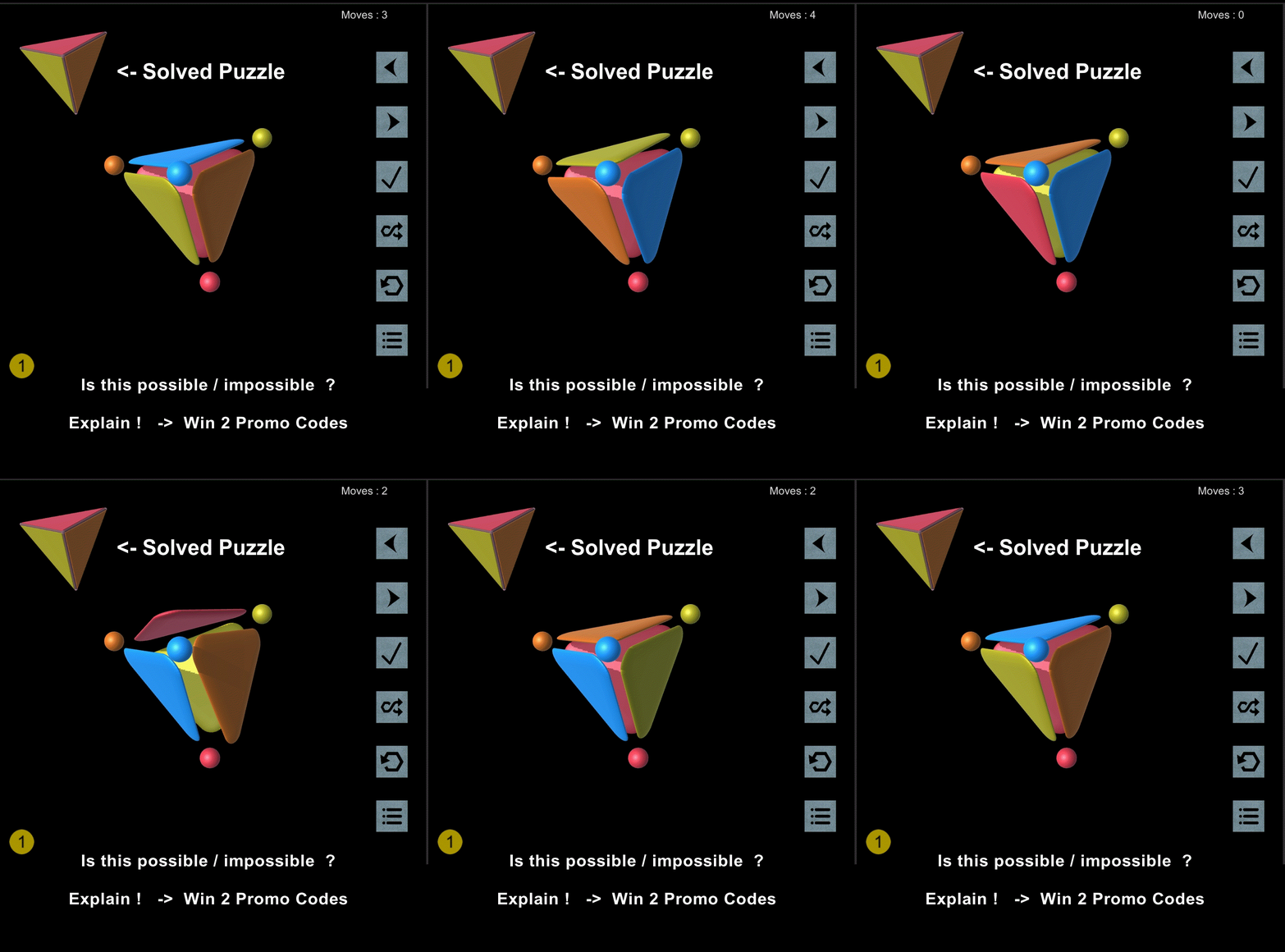
We would definitely be interested in finding two (or three) algorithms :
- One that can check whether a proposed solution pattern can actually be achieved in play, without the actual solution needed.
(A basic theory (more an idea) for this exists already. Still an occasional work in progress. - A better algorithm, to find the Gods Number for bigger puzzles.
It gets impossible very quickly to find it, when a puzzle has more than 100 million permutations
The smallest number of moves needed to solve puzzles, when found is usually astounding elegant.
These solutions are great to lkearn from & are included in the game.
Some mathematically interesting features within trinagon may hopefully be a source of inspiration for many students (of all grades) :
For example :
- platonic bodies (and other polyhedra) and many of their properties.
Even just visual representations, getting a feel for it and learning to 'see' 3D, will greatly improve the ability to work with polyhedric shapes, be it in art or in architecture (and maybe even both) or others. - general symetries in physics, chemistry and mathematics,
- vector calculus
- group theory. (Trinagon may even be a nice diversion for some particle physicists, using their understanding of dihedral groups ?)
- probability theory
A few simple 'ponderances' for students :
- How many different solution patterns (only the end positions) are there to a given colors-only puzzle ?
How does this change when you add facemarkers, and directions ? - ... and can all of them be achieved / reached in normal play ? (mostly yes, if no. Why not.).
How many can be ? (That's where it gets difficult). - Why are there exactly 6 rotationtypes ?
Or could there be more ? (Yes there could be more ! but only if ... ) - How many turns does it take to move a triangle from A to B, and how many shortest paths are there, depending on the playgound ?
- In the Icosahedron. Do 2 triangles that are as far away as they can be from each other have the same spatial orientation ? Why (not) ?
Is there a connection to how many moves it takes to move from A to B ? - Is there a useful relationship between the distance of two triangles and the number of moves to bring one to the others place, or exchange them (in the hexagon) ?
- And one out of the game :
In the tetrahedron puzzle. Use one flip-rotator (4,5 or 6) and 3 flat rotators.
Is it possible have only one triangle face flipped ?
Yes / No & Why ? :)
.. Are you sure :) ? I thought i was ! - ... make up your own. There are enough questions for all and for everyone.
After playing a while, a few good guesses might already answer some of these questions or give you an idea of how the get there.
If you have come up with questions and maybe even followed through with some answers, feel free to tweet (or X) Lumpazy @ the Trinagon Puzzle Collections.
Some things that have been considered and mostly solved :
- What makes a puzzle Unique ?
In a recent update another algorithm was integrated that can actually reduce ('collapse') the puuzzles to their actually defining base state.
The basic idea is obvious and simple. For example if a puzzle has only colors, then it doesn't matter what types of rotators it has. And the other way round : if a puzzle has no facechangers, then the faces of triangles don't matter. And so on.
Also spatial symmetry needs to be checked. E.g. The hexagons have a spatial symmetry of 6. So turning a hexagon puzzle 60 degrees, doesn't make it any diifferent.
There are some other small pitholes though : Some triangles absolutely may look the same, but on some puzzles they do NOT belong to the same group ! - Same Group. What group ?
Triangles are grouped together when they look the same, and can be moved to the same place, and there have the same orientation. Then they are interchangeable. I decided to call this a 'group'.
This also leads to the maths involved in calculating the permutations for every puzzle.
and also helps greatly with the ideas involved in solving the really hard puzzles. - Permutations of each Puzzle :
Now five years after the first launch of the game a few rather simple algorithmns have been found / made to count the total number of triangle configurations on a puzzle.
The numbers are from as small as one thinks on the smaller polyhedra to extremely huge for the larger ones. Usually we all tend to underestimate the huge amount of possible permutations.
The algorithmn only calculates exactly up to floating point value. Everything above is estimated in powers of 10.
Comparing to the Rubis cube. Trinagon has way more permutations. This is even true when triangles are interchangeable (same group, see above). - Gods Number for each puzzle :
Within all this also a solution-finding algorithmn has been checking for the best possible solutions to many puzzles. The algorithmn uses brute, but intelligent, force :).
The results of the best solutions are in my opinion : Totally astounding.
This information and the possibility to also load 'gods solution' are currently being worked into the game.
Gods solutions will only become available once a puzzle was solved. There is a learning curve and a self-rewarding curve there : It's much easier to find a really short gods solution if you know how many moves it takes. Especially on the smallest polyhedra. Therefore, let the surprise come slowly.
Comment : For the rubiks cube many solving systems have been created. Simulations were run and a lot of thinking & processing power got spent on figuring out the rubiks cubes 'Gods Number', and many mathematical papers have been written on this one single puzzle (one resource here ..), and other permutation puzzles.
There are many apps that will autosolve it for you, and there a numerous tutorials where you can learn to apply solving patterns for the rubiks cube. - Ad Brute Force :
With n rotators active there is a maximum of (2*n -1) new configurations ('states') with every move. So the number of states increases rather fast by the power of the number of moves.
Depending on the basic setup, size and rotationtypes, many states will be repeating themselves, which leads to at best a 1/3rd less that need to be stored. But this comparison is exponentially more effort.
So it is pretty clear why finding gods number is not a matter of minutes on the harder & bigger puzzles, but would take days or years to cumpute (on a regular PC). Obviously the search for a perfect solution goes from the start up, as well as from the solution downwards, and will meet in the middle.
There will often more than one gods solutions, but only one needs to be found. - Open Question : Without actually brute force Gods solution searches : Maybe any proper mathematician would like to find a proof of the existence (or absense) of a 'fitting' solution, which hasn't been played to, but simple set up with the above knowledge of interchangeables. The assumption is, that yes.
Most puzzles can be solved then, but there already is a rather simple example where this is NOT true, and quite easy to see : The impossible tetrahedron puzzle above.